
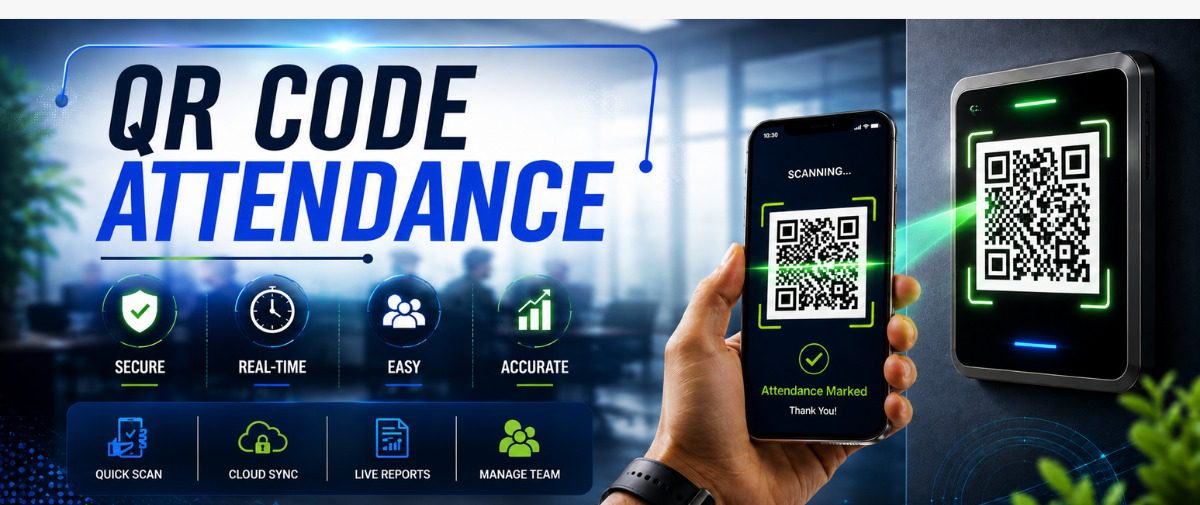
How Does QR Code Attendance Work?
QR code attendance system works by generating a unique, time-sensitive code that employees scan with their phone to clock in or out. The scan captures the time, date and location, then syncs to a dashboard instantly. The code refreshes on a schedule, closing the door on screenshot fraud and buddy punching.
Key Takeaways
- QR code attendance system replaces sign-in sheets and biometric hardware with a phone scan.
- Dynamic codes refresh automatically, stopping shared screenshots from covering a colleague’s clock-in.
- QR attendance tracking suits construction sites and multi-site teams without a fixed clock-in point.
- Scan data flows straight into payroll, cutting admin time.
- QR code attendance can be deployed in minutes without installing dedicated attendance hardware
A missed clock-in. A shared screenshot. A supervisor chasing paper timesheets across multiple sites. A QR code attendance system replaces these everyday challenges with a faster, more reliable way to track attendance.
What Is a QR Code Attendance System?
QR code attendance system lets employees clock in and out by scanning a code with their phone, replacing paper registers and biometric scanners with a dedicated QR attendance app.
Modern platforms use dynamic codes that refresh on a schedule, helping prevent attendance fraud by reducing risks such as screenshot misuse and buddy punching. This is what separates a true QR code attendance system from a simple printed QR code.
How Does a QR Code Attendance System Work?
The process works in three simple steps.
Step 1: The Employee Scans a Unique Code
The employee scans the code at the site, on a sign or a supervisor’s device, confirming presence at that time and location.
Step 2: The System Checks Time and Location
The system checks the timestamp against the roster and, where GPS is enabled, confirms location, making QR employee attendance more reliable than a signature.
Step 3: Attendance Data Syncs Automatically
Data flows into the dashboard automatically, updating timesheets and payroll in real time. This is where QR attendance management proves its worth.
Understanding how it works is only part of the story. The real value lies in the benefits it delivers to businesses.
Why Australian Businesses Are Switching to QR Attendance
Construction, logistics, hospitality and manufacturing employers are moving away from paper and biometric terminals for clear reasons
QR attendance software gives businesses greater visibility into employee attendance while reducing the administrative burden of manual record-keeping.
- Lower hardware cost. Employees use their own phones.
- Stronger fraud prevention. Dynamic codes stop buddy punching.
- Faster onboarding. New starters added in minutes.
- Better compliance. A QR code clock in system stores seven years of records securely.
- Clearer visibility. Dashboards show who is working, where and for how long.
Real-World Use Cases Across Industries
One of Australia’s largest private construction companies, mcnab, replaced paper-based site check-ins with QR code sign-ins to improve workforce visibility across construction sites.
The system provided accurate, real-time records of everyone on site and saved more than 85 hours of administrative work each week, highlighting how digital attendance supports efficient workforce management and compliance across multi-site operations.
The benefits are clear in principle. The table below shows how the method holds up directly against the two it usually replaces.
QR Code Attendance vs Traditional Attendance Methods
| Feature | QR Code Attendance | Paper Sign-In Sheets | Biometric Terminals |
| Hardware cost | Employee phones only | Minimal | High, fixed devices |
| Fraud prevention | Strong with dynamic codes |
Weak, easy to falsify | Strong |
| Setup time | Minutes | Immediate but manual | Days to install |
| Multi-site suitability | Excellent | Poor | Poor without extra units |
| Data accuracy | Automatic and real-time | Manual and error-prone | Automatic |
| Payroll integration | Direct sync |
Manual entry required | Often direct sync |
Getting the technology right is only the beginning. How it’s implemented matters just as much.
Common Mistakes and Challenges to Avoid
➔ Using static codes: Static codes do not expire, making them vulnerable to screenshots and repeated misuse. Dynamic codes provide a more secure alternative.
➔ Skipping location checks: GPS verification helps confirm employees are clocking in from the correct worksite rather than remotely.
➔ Poor connectivity planning: Low-signal sites need an QR attendance app that can capture scans offline and sync data once a connection is restored.
➔ Insufficient staff training: A short onboarding session helps employees understand the clock-in process and reduces avoidable errors.
➔ Displaying QR codes in unsecured locations: Attendance codes should only be accessible to employees who are physically present at the worksite, reducing the risk of unauthorised or proxy clock-ins.
The right platform helps businesses avoid these common pitfalls.
Why Koyyo’s Dynamic QR Code Attendance System Stands Out
Koyyo’s Dynamic QR Code Attendance System closes the gaps, static codes and older sign-in methods leave open. Codes refresh automatically, preventing screenshot fraud, and the system runs entirely from employee phones, a hardware-free clock-in option for construction sites, pop-ups and multi-site operations.
It sits within Koyyo’s broader workforce management platform, covering shift management, GPS tracking and payroll integration. Businesses wanting a biometric option can also explore facial recognition attendance and the mobile time and attendance app.
QR Code Attendance Makes Workforce Tracking Simpler
QR code attendance system turns clock-in from a paper-based chore into a scan that updates payroll on its own. It closes the fraud gap left by static attendance methods and keeps records ready for the seven years Fair Work requires.
Koyyo’s Dynamic QR Code Attendance System is built around exactly that principle.
Frequently Asked Questions
1. What is a QR code attendance system?
A digital method where employees scan a code with their phone to record clock-in and clock-out times.
2. Is QR code attendance secure against fraud?
Yes, when codes are dynamic. A refreshed code cannot be reused, which prevents buddy punching.
3. Can QR attendance work without internet access?
A well-designed QR attendance app captures the scan offline and syncs once reconnected.
4. Is QR code attendance suitable for multiple locations?
Yes, it suits multi-site and pop-up operations, since no fixed hardware is needed per site.
5. How does QR attendance help with payroll?
Scanned data syncs directly with payroll software, cutting manual entry and errors.
6. Does a QR code attendance system track location?
Many systems include GPS verification, confirming presence at the worksite when clocking in.
7. How long must Australian employers keep attendance records?
Under the Fair Work Act 2009, records must be kept for seven years.
8. What industries benefit most from QR code clock in systems?
Construction, logistics, hospitality, manufacturing and retail, with variable or multi-site shifts.
Explore More from Koyyo
- Workforce Management Platform
- Time & Attendance Management Software
- Shift Management
- GPS Tracking
- Payroll Integration
- Workforce Shift Control
- Mobile Time & Attendance Software
- Facial Recognition Attendance
- Visitor Management System
Buddy punching, lost timesheets and manual reconciliation cost Australian businesses real hours every week. Koyyo’s Dynamic QR Code Attendance System closes those gaps with a simple scan, sending accurate attendance data straight into payroll.
Contact Koyyo to learn how it can support your business.