
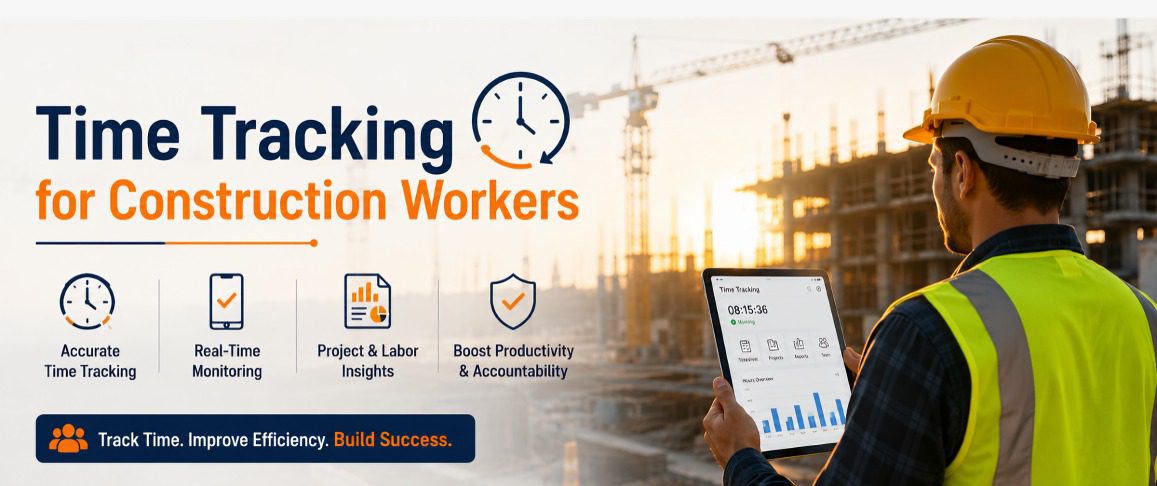
Time Tracking for Construction Workers: The Complete Guide
Featured Snippet Answer
Construction time tracking records work hours, site locations and labour costs using GPS time tracking and digital timesheets instead of paper. Workers clock in through a mobile app, their location is verified, and approved hours flow into payroll, reducing errors and improving compliance across multiple sites.
Key Takeaways
-
- Construction time tracking replaces paper timesheets with GPS-verified data.
-
- Digital records speed approvals and reduce payroll errors across sites.
-
- Field employee tracking improves accountability, safety and award compliance.
-
- Accurate labour data supports project costing, forecasting and future bids.
What Is Construction Time Tracking?
Construction time tracking records when crews start, finish and take breaks using digital tools. Modern systems combine GPS time tracking with mobile time tracking, so hours are logged as work begins and the location is verified.
For multi-site teams, digital construction timesheets put timestamped, geo-tagged records in one place, reducing the need to chase handwritten sheets or reconstruct hours before payroll.
Construction employs well over a million people across Australia, with workers covered by different awards and agreements. Safe Work Australia also identifies construction as an industry with a high share of serious workplace claims, making accurate attendance records practically important.
How Does Construction Time Tracking Work?
Step 1: Workers Clock In via Mobile or GPS
Workers use a mobile app or scan a site code. Mobile time tracking records the time, while GPS confirms the worker is within the correct site boundary.
Step 2: Location and Task Data Is Captured Automatically
The system records the site, task or cost code against the hours, which helps when workers move between projects.
Step 3: Supervisors Review and Approve Hours
Supervisors review submitted hours from a dashboard and resolve missing clock-outs or unusual entries before payroll.
Step 4: Data Flows Directly Into Payroll
Approved hours can flow into payroll, supporting overtime, allowances and penalty-rate calculations without repeated manual entry.
Benefits of Digital and GPS Time Tracking
-
- Fewer payroll errors: automated data entry reduces overpayments and underpayments, strengthening construction payroll tracking.
-
- Faster accountability: GPS time tracking gives supervisors a clearer view of who is on site.
-
- Cleaner project costing: contractor time tracking ties labour hours to the right project.
-
- Better forecasting: actual labour data helps improve future estimates and bids.
-
- Fewer disputes: verified hours create a clearer record for workers and managers.
Real-World Use Cases
Kingdom Projects, a Melbourne-based commercial builder, delivers construction projects across healthcare, aged care, education, retail and other sectors. Its work involves managing complex projects across different environments and locations, making accurate workforce coordination and labour tracking important operational considerations.
Relines Australia, based in Western Australia and operating across Australia and internationally, provides specialist mill relining services to the mining industry. The company works in challenging, time-critical environments and highlights safety, accountability and continuous improvement as part of its operations.
Both examples show why field employee tracking can be valuable for businesses managing workers across projects, sites and demanding operating environments.
Common Mistakes Construction Firms Make with Time Tracking
-
- Sticking with paper or spreadsheets: manual records can lead to rounding errors, missed breaks and incorrect overtime.
-
- Misapplying award rates: incorrect classifications and penalty payments can create payroll problems.
-
- Losing scheduling changes: workers moved between jobs may be recorded against the wrong cost code.
-
- Inconsistent site coding: different naming conventions create reconciliation work.
For award requirements, refer to the Building and Construction General On-site Award.
Manual Timesheets vs Digital Time Tracking: A Comparison
| Feature | Paper Timesheets | Digital Time Tracking |
| Location verification | None | GPS time tracking confirms site presence |
| Payroll integration | Manual re-entry | Automatic sync |
| Award interpretation | Manually applied | Automated by rule |
| Error rate | High | Low |
| Audit trail | Difficult to produce | Instant and complete |
| Approval speed | Days | Same day |
Choosing a Construction Time Tracking Solution
Look for GPS time tracking, mobile time tracking and direct payroll integration. If your business manages multiple projects or agreements, check how the system handles overtime and allowances. A simple mobile interface, reliable offline mode and clear reporting can also improve adoption across busy sites.
Why Construction Time Tracking Matters
Construction time tracking gives businesses a reliable record of hours, locations and labour costs across every site. Replacing paper timesheets with GPS-verified mobile tracking can reduce payroll errors, improve accountability and give managers better project-cost data.
For construction firms managing multiple crews or sites, the right system turns time records into information they can use for payroll, compliance and future planning.
Frequently Asked Questions
1. What is construction time tracking?
It is the digital recording of work hours, site locations and labour costs, replacing paper timesheets with real-time data.
2. How does GPS time tracking work on construction sites?
It verifies a worker’s location at clock-in or clock-out, often using a defined geofence around the site.
3. Can mobile time tracking work without internet access?
Our systems store entries locally and sync them when a connection becomes available.
4. Why do construction firms use digital timesheets?
They reduce manual errors, improve record accuracy and make hours easier to review and approve.
5. How does contractor time tracking support multiple projects?
It links hours to the relevant project or cost code, helping keep labour costs tied to the right job.
6. Does digital time tracking support payroll compliance?
It provides accurate records for reviewing hours, overtime, allowances and relevant award requirements.
7. How does field employee tracking support site safety?
It gives supervisors a clearer view of who is on site, which can support incident and evacuation response.
8. What should a construction business look for in a time tracking system?
Look for GPS verification, mobile access, payroll integration, clear reporting and support for overtime or award rules.
Explore Koyyo Features
-
- Workforce Management Platform: https://koyyo.co/workforce-management-platform/
-
- Construction Industry Solution:https://koyyo.co/industries/construction/
-
- Time and Attendance Management Software: https://koyyo.co/industries/time-attendance/
-
- GPS Tracking: https://koyyo.co/industries/gps-tracking/
-
- Payroll Integration:https://koyyo.co/industries/industries-payroll-integration/
-
- Workforce Shift Control: https://koyyo.co/industries/workforce-shift-control/
-
- Facial Recognition Attendance: https://koyyo.co/facial-recognition-attendance/
-
- Mobile Time & Attendance Software: https://koyyo.co/mobile-time-attendance/
Manual timesheets slow construction teams down and leave payroll accuracy to chance. Koyyo helps construction firms replace paper records with GPS-enabled, mobile-ready time tracking built for multi-site teams.
Discover how Koyyo can help your construction team capture accurate hours, improve workforce visibility and run payroll with greater confidence.